As a dedicated player who has spent countless hours behind the virtual wheel, I've always been fascinated by the layers beneath the polished asphalt of the Forza series. It's a franchise that feels both monumental and intimately detailed, a world built on real-world passion and digital craftsmanship. From the roaring engines of the first Forza Motorsport to the sun-drenched festivals of Forza Horizon 5, this journey has been filled with more than just perfect drifts and photo finishes. Over the years, I've discovered that the series harbors a treasure trove of secrets, oddities, and behind-the-scenes stories that reveal the complex, sometimes quirky, reality of its development. These aren't just Easter eggs; they're glimpses into the challenges, partnerships, and creative decisions that have shaped one of gaming's most beloved racing dynasties. Let me take you on a tour of some of the most intriguing facts I've uncovered about this incredible franchise.

One of the most pivotal secrets isn't about a car, but about the people who build the worlds we drive in. Many fans know Playground Games as the brilliant minds behind the Horizon series, but back when the first Forza Horizon was being conceived, they were a relatively unknown and untested studio. I remember the skepticism in the community. Handing over a flagship branch of the franchise to a new team? It seemed like a huge gamble for Turn 10 Studios. However, the director of Turn 10, Dan Greenawalt, saw their potential from the very beginning. In an interview, he expressed his confidence, focusing on Playground's "tremendous pedigree." Looking back now, with the monumental success of Horizon 5, that partnership wasn't a risk—it was a masterstroke. It's a reminder that sometimes the biggest leaps forward come from trusting new talent with a fresh vision.
The world of car licensing in video games is a complex and secretive arena, and Forza's history with Porsche is a perfect example. For years, I, like many players, wondered why Porsche cars felt like special, limited-time guests in the earlier games. The reason was a corporate secret: the license for Porsche in video games was exclusively held by Electronic Arts (EA). This meant that for titles like Forza Horizon 2, the inclusion of these iconic cars was a significant negotiation. It wasn't until 2016 that this exclusive arrangement ended in a mutual parting of ways. The fascinating part? This behind-the-scenes corporate shift was almost invisible to us players. One day, Porsches were a coveted DLC; the next, they were seamlessly integrated into the core garage, as naturally as they are in Forza Horizon 5 today. It shows how business deals we never see directly shape the cars we get to drive.
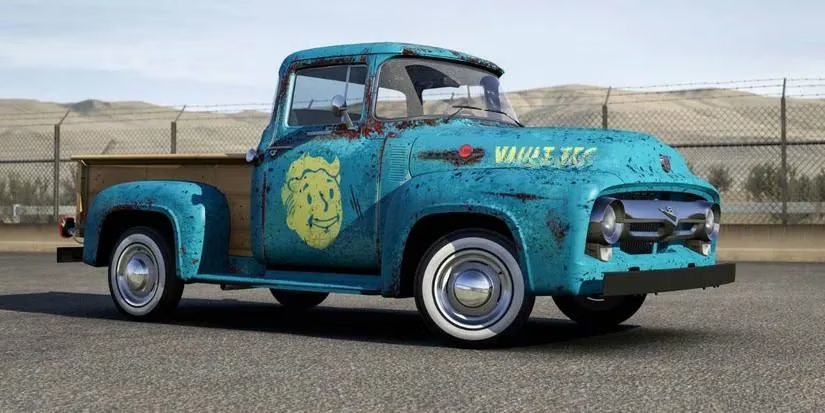
While Forza is grounded in automotive realism, its developers have never been afraid to have fun with fiction. I've had some of my most memorable drives not in a hypercar, but in vehicles ripped straight from other universes. The series has a rich history of crossover content that often goes beyond simple promotions. Sure, there are the expected cars from Fast & Furious or James Bond, but the roster gets wonderfully weird. I've piloted the hulking Warthog from Halo across the Australian outback in Horizon 3 and taken the futuristic Quadra from Cyberpunk 2077 for a spin in Britain. One of my personal favorites was discovering the Chryslus Rocket 69 from the Fallout universe in Forza Motorsport 6. These aren't just reskins; they are lovingly detailed models that feel both alien and perfectly at home on the track. It's a secret celebration of pop culture that adds a layer of pure, unadulterated joy to the simulation.
Sometimes, the secrets are hidden in plain sight, in the details we're racing too fast to notice. If you ever slow down enough in Forza Motorsport 6 to glance at the crowds lining the tracks, you might spot a curious graphical quirk. To save on resources, the developers reused character models for the spectators. This means you'll often see clusters of identical people—same face, same clothes, same pose—standing together, like a family of clones brought out to watch the race. It's a charmingly imperfect detail, a small concession to the immense processing power required to render hundreds of unique individuals. It reminds me that even in a series known for its visual fidelity, clever shortcuts are part of the magic.
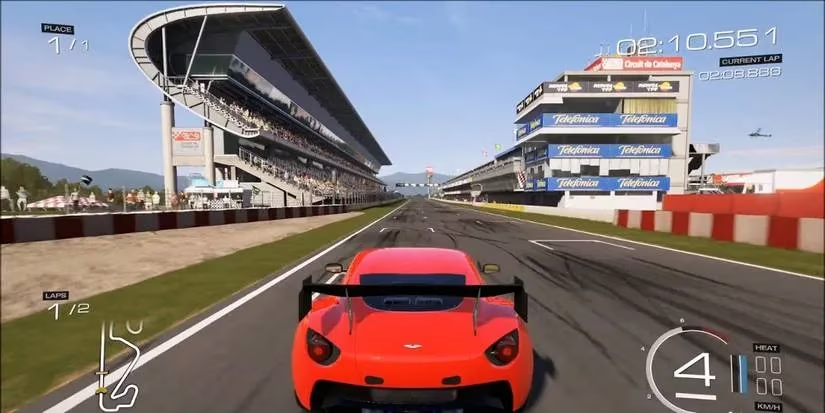
Speaking of crowds, earlier games had a more logical, if slightly lonely, approach to solo driving. In Forza Motorsport 3 and 4, when I would choose to simply "hot lap"—driving alone on a track to practice or enjoy a car—the grandstands would be completely empty. It made perfect sense: why would spectators show up for a non-event? This attention to situational detail was a neat, immersive touch. However, this feature quietly disappeared in later titles. Now, whether I'm in a championship race or a solitary time trial, the crowds are always there, perpetually cheering. It's a small regression in realism that I sometimes miss, a secret bit of logic sacrificed for consistent visual spectacle.
The pursuit of performance in Forza often leads us to the upgrade menu, where weight reduction is a key modification. In the older Motorsport titles, this upgrade had a visible, tactile consequence: it would physically remove the passenger seat from the car's interior model. Seeing that empty space where a seat once was added a satisfying layer of authenticity to the tuning process. This detailed feature, unfortunately, was largely phased out in later games. The weight reduction still happens statistically, but the visual change is gone. Here's a quirky secret, though: in Forza Motorsport 7, this old-school detail survives for at least one vehicle—the Plymouth Barracuda. Apply weight reduction, and the passenger seat vanishes. It's a delightful anachronism, a single car holding onto a piece of the series' past.
Diving into cockpit view reveals another layer of hidden detail. Among the hundreds of meticulously modeled interiors in the Motorsport games, only a select few cars have a fully modeled key in the ignition. It's a completely insignificant detail for gameplay, but for car enthusiasts, it's a delightful find. I remember spotting it first in the Nissan Skyline R32 and R33, the tiny key hanging there with surprising detail. Yet, in the more famous R34 Skyline, the key is absent. It's not just Nissans, either; cars like the Porsche Macan and the classic Sunbeam Tiger also have this tiny feature. There's no rhyme or reason to which cars got this treatment—it's a secret nod to the artists who poured love into specific models, adding character where few would ever think to look.
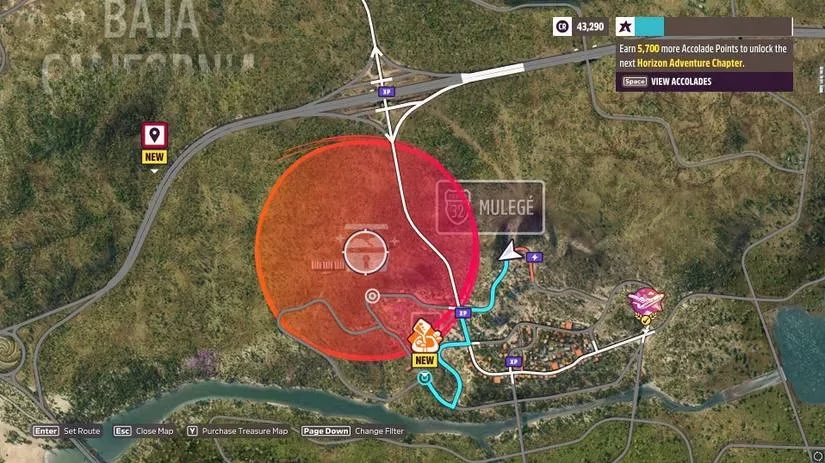
The choice of Mexico as the setting for Forza Horizon 5 felt inspired, but the reasoning behind it is a beautiful secret shared by the developers. Creative Director Mike Brown explained that Mexico is "almost like the whole world in one country." As I drive from the ancient jungles to the snow-capped volcanoes, from sun-bleached deserts to lush coastlines, I understand completely. This diversity wasn't just a graphical showcase; it was a deliberate design philosophy to create the most explorable and varied open world yet. Beyond the landscape, the team was drawn to Mexico's vibrant, globally beloved culture—its art, music, and people. This secret ingredient of cultural authenticity is what makes Horizon 5's world feel truly alive, not just a pretty backdrop for races.
This diverse setting directly enables one of the game's most technically impressive secrets: truly localized and dynamic weather. In Horizon 5, I can be racing under a blistering sun in the desert while a tropical storm lashes the jungle just a few miles away. The weather isn't just a global state; it's a biome-specific, evolving system that profoundly affects handling and visibility. Driving a rally car through a sudden downpour in the canyon feels fundamentally different from cruising a supercar along a damp coastal highway. This level of environmental simulation creates an unparalleled sense of place and makes every journey unpredictable.
Finally, one of the most cutting-edge secrets isn't something you see, but something you hear. Forza Horizon 5 implements a revolutionary form of ray-traced audio. We're familiar with ray-traced graphics for stunning lighting, but here, the same principle is applied to sound. The game's engine calculates how sound waves travel and bounce off the environment in real-time. This means the roar of my engine changes dramatically if I'm blasting down a narrow city street versus cruising across an open plain. The ambient sounds of wildlife, weather, and culture warp and shift based on my speed, my car, and my surroundings. It's a secret layer of immersion that works on a subconscious level, making the world of Horizon 5 feel tangibly, audibly real. It's a quiet testament to the series' commitment to pushing technological boundaries in every dimension. From corporate deals to cloned spectators, from missing car keys to sonic ray-tracing, the Forza franchise is built on a foundation of these fascinating stories. They are the hidden mechanics, the forgotten features, and the passionate decisions that, together, make this virtual driving experience so uniquely compelling and enduring.
Comments